M&A Due Diligence AI: A 2026 Buyer's Guide for Deal Teams
Discover what deal teams should look for in AI due diligence software in 2026 - traceability, auditability, and continuous monitoring for M&A deals.
Quick Answer
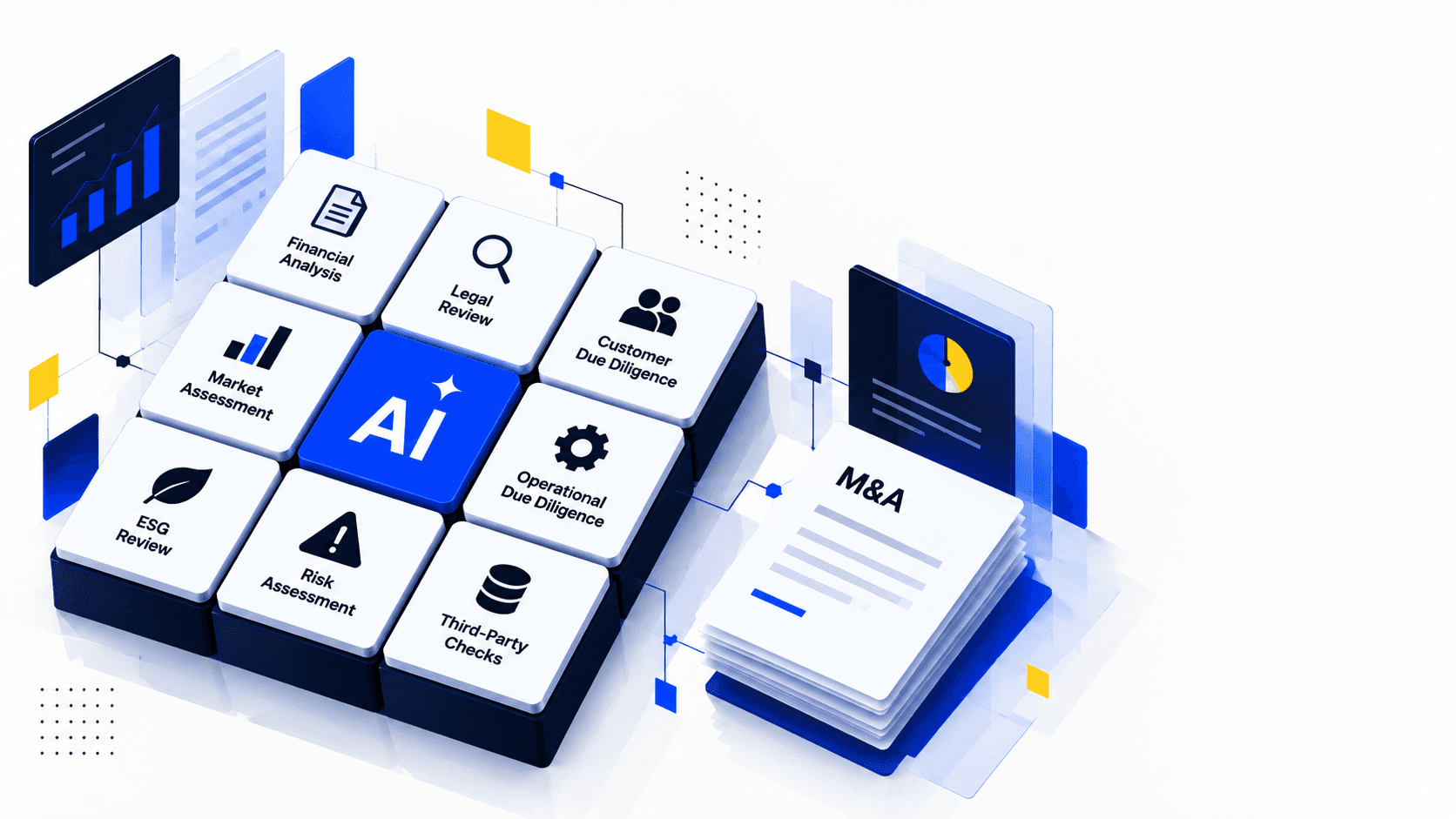
M&A due diligence software is worth buying when it produces research that can be traced to sources, reviewed by humans, and defended in an investment committee or regulatory process. Generic assistants can accelerate drafting, but an AI-powered due diligence platform must preserve evidence, handle repeatable investigation logic, and support continuous monitoring after a transaction is signed.
Introduction
Slow or unreliable diligence costs deal teams more than analyst hours: it can delay signing, weaken negotiating leverage, and leave material risk undiscovered until after close. Due diligence for mergers and acquisitions requires a defensible record across financial, legal, ownership, regulatory, cyber, and counterparty questions, not a plausible narrative assembled from disconnected searches. The practical test in 2026 is whether a system can turn evidence into a reviewable deliverable while showing how each conclusion was reached. A three-year financial-document lookback, according to DFIN Solutions, is one example of the evidence depth that can materially affect valuation, approvals, indemnities, and remediation work. IT diligence should also examine hardware and software resources, while cyber diligence investigates IT systems, software, intellectual-property security, and potential cyber risks. DFIN Solutions also notes that diligence findings can significantly affect the final deal price, making complete evidence collection relevant to both risk assessment and transaction economics.
Key Takeaways:
Require citations, decision trails, and human review for every material diligence conclusion.
Prioritize continuous monitoring when deal risk can change between diligence and closing.
Pilot against a real transaction workstream before expanding across the deal team.
How to Evaluate M&A Due Diligence Software
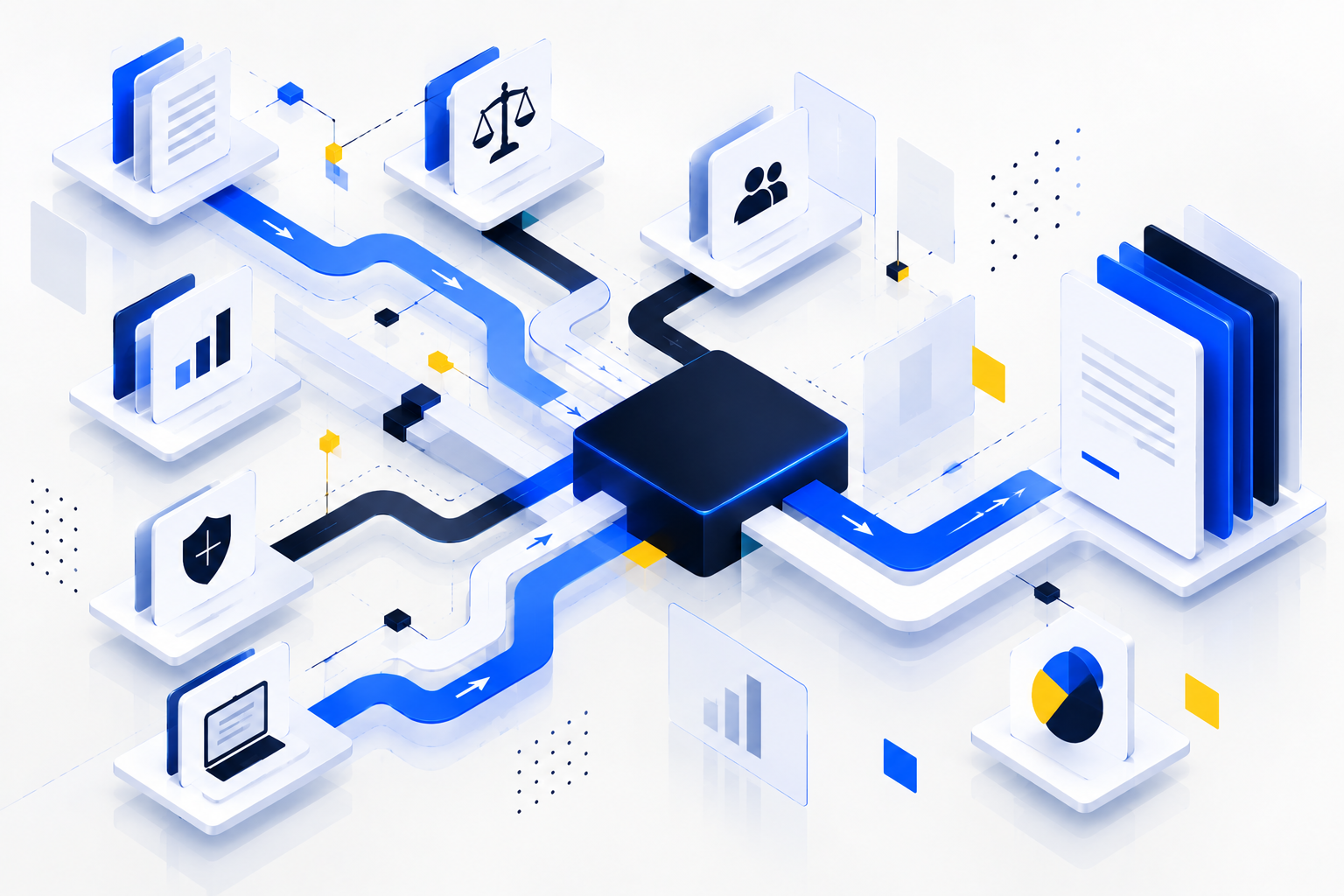
Serious M&A due diligence software should reduce repetitive research without asking a deal team to lower its evidentiary standard. The evaluation should start with the deliverable: an investment committee memo, risk register, board deck, or closing-condition analysis that names sources, separates facts from judgment, and gives a reviewer enough context to challenge the result.
Start with the evidence chain, not the chat interface
An AI agent is useful only if its outputs retain the underlying sources, document the research path, and make exceptions visible to legal, compliance, and deal leads. That standard aligns with the AI Risk Management Framework's focus on governing and managing AI risk, rather than treating an answer as reliable merely because it sounds polished.
Source citations: Link each material claim to its underlying evidence.
Review controls: Route high-consequence findings to accountable human owners.
Decision trails: Preserve inputs, findings, revisions, and approvals for later review.
Scoped access: Limit credentials and data access to the required work.
Output formats: Export findings into reports, slides, spreadsheets, and risk registers.
Test the platform on a realistic diligence question
Ask vendors to investigate a live-style question with ambiguous information, such as ownership changes, litigation exposure, sanctions-adjacent concerns, or regulatory developments across jurisdictions. The output should identify gaps and conflicting evidence instead of filling uncertainty with confident prose. This is where deep research capabilities matter: the work must move from open-ended research to a deliverable that a senior reviewer can interrogate.
One-time questionnaires and document extraction are workflow automation. AI agents for high-stakes M&A work should instead apply a defined investigation process, assemble cited findings, and retain enough context for an analyst to review the reasoning. A platform that only summarizes uploaded files may improve throughput, but it does not replace the external research and evidence reconciliation required for a defensible deal record.
AI-Powered Due Diligence Platform Criteria That Matter
Deal teams should compare platforms on proof, monitoring, deployment, and reporting rather than on generic claims about automation. Legal and regulatory exposure changes throughout a deal cycle. Under the HSR Act, certain large transactions require pre-merger notifications with the FTC and DOJ Antitrust Division; Woodbridge International notes that timely and accurate reporting is important for demonstrating compliance and avoiding penalties. M&A transactions may also trigger the WARN Act, which requires advance notice of certain workforce reductions. A strict deal timeline, often compressed to a matter of months from signing to close, incorporates these regulatory steps alongside the substantive review of corporate governance and M&A activism trends shaping deal structure.
Compare research systems by control, not novelty
The table below separates broad-purpose assistants from systems designed for auditable diligence work. Pricing varies by deployment and scope, so buyers should distinguish published self-serve pricing from custom enterprise arrangements rather than infer a total implementation cost.
Evaluation criterion | Generic AI assistant | Workflow automation | Custom diligence agents |
|---|---|---|---|
Primary output | Drafts and conversational answers | Completed task steps | Citation-backed research deliverables |
Evidence review | Depends on user verification | Tracks process completion | Preserves sources and decision trails |
Investigation logic | Prompt-dependent | Rules and routing | Custom research process for a use case |
Ongoing risk coverage | Ad hoc queries | Scheduled tasks | Event-triggered and scheduled monitoring |
Enterprise deployment | Varies by provider | Varies by provider | Can include SSO and VPC deployment |
The key difference is accountability. A conversational answer can be a useful starting point, but a board-ready diligence conclusion requires cited evidence, review ownership, and a record that remains available after the deal team has moved on.
Grep is designed for this higher bar through custom agents that produce traceable, citation-backed reports, slide decks, and spreadsheets for high-stakes research. Its AI due diligence workflows can be paired with Loops and Monitors for scheduled or event-driven screening, so the research record can continue to surface website, leadership, job-posting, regulatory, and compliance changes. Teams can also connect this work to M&A research workflows, an investment diligence platform, and enhanced due diligence processes when the investigation requires additional screening.
Make continuous monitoring part of deal-prep
Risk does not pause after the initial diligence report is approved. Continuous monitoring for deal-prep is especially important when a target's leadership, web presence, regulatory posture, or operating signals may change before close, while post-close teams also need a structured way to watch emerging issues. Woodbridge International describes a strict 150-day deal timeline that incorporates steps following early regulatory analysis, illustrating why subsequent monitoring should be connected rather than treated as a separate project.
What Leading Platforms Must Prove Before a Pilot
Leading enterprise due diligence solutions do not win because they generate more text. They prove that a deal team can configure a repeatable investigation, restrict access appropriately, review citations, and convert findings into decisions without rebuilding the work in a separate system.
Run a narrow, evidence-heavy pilot
A practical pilot starts with one workstream that is consequential but bounded, such as target-company background research, executive screening, regulatory exposure mapping, or enhanced due diligence on a counterparty. Give the platform a representative question set, define required sources and escalation rules, then compare its report with the team's existing research record for completeness, citation quality, unresolved conflicts, and review effort.
For large organizations, deployment questions deserve equal weight with research quality. Assess whether the system can support shared agents, access controls, review ownership, and deployment requirements that match the organization's governance model. The scope of a pilot, the sensitivity of the source material, required integrations, and procurement terms determine the appropriate commercial arrangement; confirm current pricing and deployment details directly before procurement.
Reject black-box claims and isolated outputs
Do not accept a demo that cannot show source-level support, a reviewer workflow, and a clear treatment of uncertainty. For cyber- and data-sensitive transactions, test whether the investigation covers IT systems, software, intellectual-property security, and potential cyber risks; Drooms identifies these areas as central to IT due diligence. If the workflow handles sensitive documents, confirm how secure access and collaboration are managed within a GDPR-compliant platform. Perplexity has described agent tasks running in an isolated compute environment with a filesystem, browser, and tool integrations, but deal teams still need to test whether any system's evidence chain and governance fit their own approval process.
Grep's stated security and governance posture includes SOC 2 and GDPR, no model training on customer data, scoped least-privilege credentials, configurable retention, delete-on-request controls, and exportable decision trails for audit. Those controls should be reviewed alongside the actual agent design, because auditable due diligence for M&A transactions depends on how the system handles the specific sources, permissions, and review steps in a deal workflow.
Conclusion
Buy an AI system for diligence only when it can make the research faster without making the decision less defensible. Start with evidence traceability, human review, access controls, and continuous monitoring, then prove performance on a real workstream before expanding. For teams that need custom agents, board-ready deliverables, and ongoing screening rather than a generic chat layer, evaluate whether the platform's operating model fits the required evidence, permissions, and reviewer workflow. The next step is to define one diligence question, its required evidence, and the reviewer who must sign off on the result.
Ready to test a defensible research workflow? Explore Grep through a focused M&A diligence pilot.
Frequently Asked Questions (FAQs)
How to automate M&A due diligence for large enterprises?
Automating M&A due diligence for large enterprises means assigning repeatable research tasks to controlled agents while retaining human approval for material findings, using source citations, permissioned data access, escalation rules, and exportable records that fit legal, compliance, corporate development, and investment committee review.
What is the role of AI agents in high-stakes due diligence?
The role of AI agents in high-stakes due diligence is to execute defined investigation steps, gather and reconcile evidence, identify gaps, and produce reviewable outputs, while accountable deal professionals remain responsible for interpreting risk, resolving uncertainty, and approving transaction decisions.
Why choose AI-powered agents for board-ready due diligence?
AI-powered agents support board-ready due diligence when they generate cited reports and preserve decision trails, because directors and investment committees need to inspect the factual basis, uncertainty, and review process behind conclusions rather than receive an unsupported summary.
Can AI agents handle traceable and auditable compliance work?
AI agents can handle traceable and auditable compliance work when their design records sources, access boundaries, research steps, reviewer changes, and approvals, allowing teams to show how a finding was developed and where human judgment affected the final decision.
Is AI research for M&A defensible to regulators?
AI research for M&A is defensible to regulators only when the organization can demonstrate reliable source handling, documented review, appropriate controls, and accountable decision-making, since a generated conclusion alone does not establish that required diligence or reporting was performed.
What is the difference between AI agents and workflow automation for M&A?
The difference between AI agents and workflow automation for M&A is that automation routes forms, tasks, and approvals through predefined steps, while agents can conduct structured research, synthesize cited evidence, surface contradictions, and prepare decision materials within controlled review processes.
About the Author
AJ Asver is the Founder and CEO of Grep, where he works on custom AI agents for due diligence, compliance oversight, and other high-stakes enterprise workflows. A four-time founder and Oxford computer science graduate, he previously built fintech products at Coinbase and Brex after selling his first startup to Google. Connect on LinkedIn.