The Real Cost of Bad Research: When AI Gets It Wrong
Bad research doesn't cost time — it costs decisions. And in regulated industries, bad decisions cost everything.
1Bad Research Doesn't Cost Time — It Costs Decisions
When organisations evaluate research tools, they almost always frame the value proposition in terms of time savings. "This tool will reduce research time by 80%." "Your analysts will save 20 hours per week." The efficiency framing is intuitive, measurable, and easy to justify in a budget meeting.
But it profoundly misunderstands what research is for. Research exists to inform decisions. A research tool that saves 20 hours but produces unreliable output hasn't saved anything — it has manufactured confidence in conclusions that may be wrong. The time was never the cost. The decision was.
Consider what happens when a compliance team acts on flawed research: a client is onboarded that should have been declined. An investment is made based on a competitive landscape analysis that missed a crucial competitor. A regulatory filing is prepared using data that was fabricated by an AI tool. In each case, the "time saved" by the research tool is irrelevant compared to the cost of the resulting decision.
- Onboarding risk: A single client onboarded based on incomplete due diligence can expose an institution to sanctions violations, money laundering liability, or reputational damage worth multiples of the entire compliance budget
- Investment risk: An investment decision based on AI-generated analysis that missed material red flags can result in total capital loss and LP trust erosion
- Regulatory risk: Filings prepared using unverified AI output create regulatory exposure — not just for the error itself, but for the apparent failure of the compliance programme that allowed it
2Case Study: The VC That Missed the Red Flags
A mid-tier venture capital firm adopted AI research tools to accelerate its due diligence process. The promise was compelling: what previously took 30-40 hours of associate time could now be completed in 2-3 hours. The firm integrated AI-generated company profiles, competitive analyses, and founder background checks into its standard investment memo process.
For six months, the system appeared to work beautifully. Memos were produced faster, partners reviewed more deals, and the firm's throughput increased significantly. Then a portfolio company imploded — and the post-mortem revealed that the AI-generated due diligence had missed critical information.
The founder's background check had reported a clean history. In reality, the founder had been involved in a prior venture that had faced regulatory action — information that was available in public records but hadn't been surfaced by the AI tool. The competitive landscape analysis had described the market as "early stage with limited competition." A thorough manual review later revealed three well-funded competitors that the AI had simply failed to identify.
- Fabricated absence: The AI tool didn't report that it couldn't find information — it reported that no adverse information existed, which is a fundamentally different claim
- Confirmation bias amplification: The AI-generated memo reinforced the investment thesis without presenting countervailing evidence, creating a false sense of comprehensive diligence
- Compounding effect: The firm's partners, trusting the AI-generated research, reduced their own independent investigation — allowing the gap in coverage to persist undetected
The financial loss from the failed investment was significant, but the reputational damage was worse. The firm's LPs questioned whether the due diligence process was sound, prompting a full review that consumed months of partner time and resulted in the firm reverting to largely manual processes.
3Case Study: The Compliance Team That Missed Sanctions Exposure
A global financial institution implemented AI-powered screening to accelerate its client onboarding process. The tool was designed to check prospective clients against sanctions lists, PEP databases, and adverse media sources. Initial testing showed impressive accuracy rates against known positive cases, and the tool was deployed across the institution's commercial banking division.
Eight months after deployment, a routine regulatory examination identified a client relationship that should have been flagged during onboarding. The client was a corporate entity with beneficial owners who appeared on a regional sanctions list. The AI screening tool had correctly identified the entity's name but had not resolved the beneficial ownership chain — the individuals on the sanctions list were two layers removed from the entity that opened the account.
- Surface-level screening: The AI tool screened entity names but did not conduct the deeper corporate structure analysis needed to identify beneficial owners connected to sanctioned parties
- False negative confidence: The tool's "clear" result was treated as a comprehensive screening determination, when in reality it only covered a portion of the required due diligence
- Audit trail gaps: When examiners requested documentation of the screening process, the AI tool's output showed the searches performed but not the searches that should have been performed and weren't
- Systemic risk: The examination prompted a review of all clients onboarded using the AI tool, revealing additional cases where beneficial ownership screening had been insufficient
The regulatory consequences included a consent order, a substantial civil money penalty, and a requirement to conduct retroactive enhanced due diligence on all clients onboarded during the period. The total cost — regulatory penalties, remediation, and reputational damage — exceeded what the institution had spent on compliance technology over the previous five years.
4The Cascading Failure Model: How Bad Research Compounds
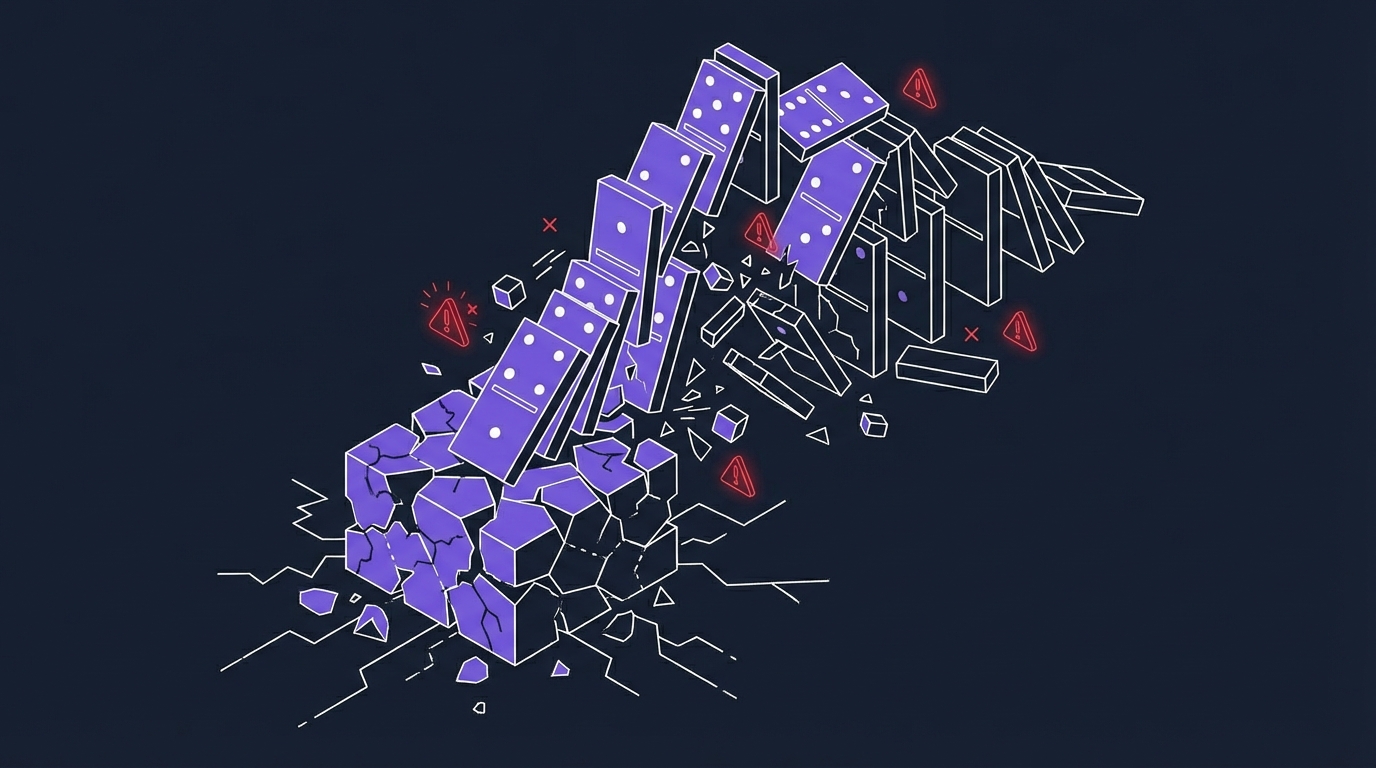
Bad research doesn't fail in isolation. It fails in cascades. The initial error — a missed fact, a fabricated citation, an incomplete screening — sets off a chain of downstream consequences that amplify the damage far beyond the original failure.
Understanding this cascading failure model is essential for evaluating the true cost of unreliable research tools:
- Stage 1 — The initial error: An AI tool produces an incorrect finding or misses a material fact. At this stage, the error is containable if detected
- Stage 2 — The confident report: The error is incorporated into a research memo or screening report, presented alongside verified information, and delivered to decision-makers without distinction between verified and unverified claims
- Stage 3 — The decision: Decision-makers act on the report — onboarding a client, making an investment, filing a regulatory document — incorporating the error into a consequential action
- Stage 4 — The compounding: The initial decision creates secondary consequences — additional transactions with the incorrectly onboarded client, follow-on investments in the poorly diligenced company, regulatory reliance on the flawed filing
- Stage 5 — The discovery: The original error is discovered — through regulatory examination, market events, or adverse outcomes. By now, the cost of remediation has multiplied exponentially
The critical insight is that the cost of catching an error at Stage 1 is trivial compared to discovering it at Stage 5. A research tool that catches errors before they enter reports is orders of magnitude more valuable than a fast tool that lets errors through. Speed without verification isn't efficiency — it's accelerated risk accumulation.
5Why Receipt-Based Research Is the Standard
The common thread in every research failure is the absence of verifiable citations. When a research tool presents findings without linking each claim to a specific, accessible primary source, there is no mechanism to distinguish accurate findings from fabricated ones until damage has already occurred.
Receipt-based research — where every factual claim comes with the source document that supports it — is not a quality tier or a premium feature. It is the minimum standard for any research that informs consequential decisions. The concept is straightforward: if you can't show where a fact came from, it isn't a fact. It's a claim.
- Immediate verification: Decision-makers can verify any claim in a research output by clicking through to the primary source — no additional research required
- Error detection at Stage 1: When citations are present, reviewers can catch errors before they enter the decision chain — the cheapest possible point of intervention
- Regulatory defensibility: Audit trails that include primary source documentation demonstrate the quality of the research process, not just the outcome
- Accountability architecture: When every claim has a source, responsibility for errors can be traced — was the source wrong, was the AI's interpretation wrong, or was the source misapplied?
GREP AI was built around this principle. Every finding in a GREP AI research output links to the primary source that supports it. This isn't a feature added to make the product more defensible — it's the core architecture that makes the research trustworthy. In a world where AI-generated research can be wrong nearly half the time, the receipt isn't a nice-to-have. It's the entire value proposition.
Ready to Put This Into Practice?
Try Grep free and see how AI-powered research can transform your workflow.
Try GREP AI Free