AI Competitor Research vs Manual Tracking: Worth It in 2026?
Manual tracking or AI-driven competitor research: which holds up under scrutiny in 2026? See the tradeoffs in speed, accuracy, and auditability explained.

Quick Answer
AI competitor research is worth adopting in 2026 when it produces traceable evidence, preserves source context, and supports human review. Manual tracking still matters for judgment calls and escalation decisions, but it cannot reliably maintain current intelligence across a large portfolio of companies, vendors, or counterparties.
Introduction
For AI for high-stakes due diligence, the decision is not automation versus rigor. The real choice is whether research can remain current, attributable, and reviewable as entity volume grows. Manual spreadsheets and recurring analyst searches create gaps between checks, while generic AI can create a different problem when it cannot show how it concluded. Bad research does not only consume time. It weakens the evidence behind a decision.
Key Takeaways:
Continuous monitoring reduces the staleness created by one-time research snapshots.
Traceable sources matter more than fast summaries in regulated decision-making.
Human reviewers should retain ownership of material findings and escalation decisions.
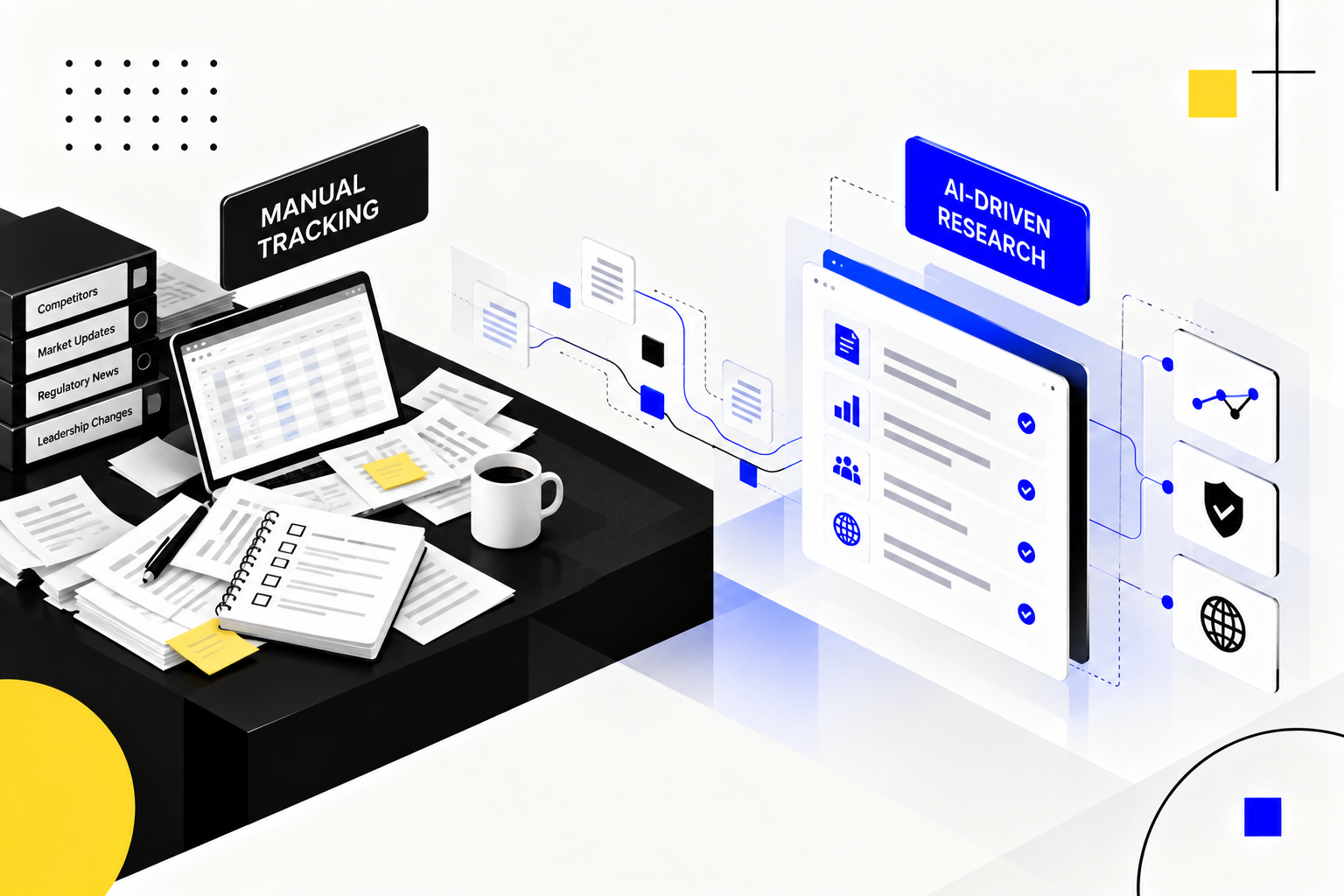
Competitor Research for High-Stakes Decisions
Competitor research in a compliance, investment, or risk setting means more than reading earnings coverage or tracking product announcements. Teams need to assess ownership changes, leadership appointments, litigation, regulatory actions, hiring signals, public statements, and changes to a company's operating footprint. The work becomes difficult when every entity requires the same disciplined evidence trail, even though its risk profile and monitoring triggers differ.
What Manual Tracking Actually Involves
Manual tracking relies on analysts to find information, evaluate relevance, record findings, and return to the same sources later. It can support nuanced analysis, particularly where an investigator must interpret conflicting evidence, but its quality depends on consistent search behavior and clear documentation standards. A comparison with manual research should account for the work required to prove that a search was complete, not merely the time required to write a summary.
Source discovery: Analysts search filings, news, websites, and public records.
Evidence capture: Findings require links, dates, excerpts, and reviewer notes.
Refresh discipline: Teams must decide when each entity needs rechecking.
Escalation review: Material changes require judgment and documented follow-up.
What AI-Driven Research Changes
AI-driven research changes the operating model when it can execute defined research tasks repeatedly, collect evidence, and report changes against a stated scope. It does not eliminate the need for policy, review, or accountable ownership. It makes competitive intelligence efforts more durable by moving routine collection and change detection away from calendar-driven analyst work and toward persistent coverage.
AI-Driven Continuous Monitoring for Financial Services
Always-on research is most useful when change itself creates risk. A counterparty may alter its leadership, expand into a new jurisdiction, publish a materially different website claim, post roles that signal strategic movement, or face a new regulatory development. Those signals may not warrant an immediate adverse finding, but they can justify a focused human review before a relationship, transaction, or investment decision advances.
Speed, Cost, Accuracy, and Defensibility
Manual tracking and AI monitoring serve different parts of the research lifecycle. Manual work remains valuable for complex interpretation, source conflict resolution, and decisions that require a reviewer to apply policy. AI research can cover recurring collection and structured monitoring, provided the system returns evidence that a reviewer can inspect and challenge.
This comparison separates operational speed from evidentiary quality, because fast output without verifiable support is not defensible in a board package, investment committee memo, or regulatory review.
Decision criterion | Manual tracking | AI-driven research | Control required |
|---|---|---|---|
Research cadence | Periodic analyst-led checks | Scheduled or event-triggered runs | Defined coverage and escalation rules |
Source coverage | Limited by researcher time | Can repeat broad source review | Approved source boundaries |
Freshness | Stale after completion | Updates when monitored signals change | Clear materiality thresholds |
Accuracy review | Reviewer evaluates each finding | Reviewer verifies material outputs | Citations and exception handling |
Audit defensibility | Depends on analyst documentation | Depends on retained evidence trails | Exportable records and ownership |
The practical recommendation is not to automate judgment. Automate repeatable evidence collection, then direct expert attention toward findings that change risk, valuation, onboarding, or approval decisions.
Trustworthy AI requires context-specific tradeoffs among reliability, accountability, transparency, explainability, privacy, safety, security, and resilience, according to trustworthy AI characteristics. NIST also states that human judgment should determine the relevant metrics and threshold values, which means a compliance team must define what qualifies as a material alert rather than accepting an opaque default.
Why Generic AI Cannot Carry the Entire Burden
Generic assistants can help generate questions, summarize supplied material, and accelerate early research framing. They are less suitable when a team must demonstrate source completeness, reproduce the research path, or distinguish verified evidence from inference. NIST warns that opaque AI systems can complicate risk measurement and limit explainability or interpretability.
That limitation defines the difference between AI research tools and AI agents in high-stakes work. A research assistant may answer a question once, while a configured agent can run a defined assignment, preserve citations, and deliver a reviewable output under an established control framework. Grep's deep-research approach focuses on citation-backed reports, slide decks, and spreadsheets for due diligence, institutional onboarding, and compliance reviews. Wisdom Ventures Operating Partner Zoe Rogers describes this kind of agent-led research as "effectively filling part of the analyst function as the firm scales," a relevant example of what a configured agent can absorb beyond a one-off query.
Building a Defensible Monitoring Model
A defensible model starts with the entity, the decision, and the evidence standard. Define which companies require ongoing scrutiny, which signals matter, which sources are allowed, and who owns each escalation. Financial institutions should also recognize that ongoing monitoring does not require customer information updates on a specific continuous schedule under the CDD Rule, so review frequency should follow documented risk and trigger logic.
Use Loops and Monitors for Repeatable Coverage
Grep's Loops and Monitors separate recurring work from continuous observation. Loops can run research on a schedule or after a real-world event, while Monitors watch companies for website, leadership, job-posting, regulatory, and compliance changes across regions. That structure supports configurable AI research loops and monitors without treating every detected change as a compliance conclusion. Shopmonkey closed 64 research jobs in its first 30 days on Grep and cut underwriting research time from hours to minutes per account, beating Gemini head-to-head, an example of what this coverage model can deliver in practice.
Keep a Human Decision Layer
Assign reviewers to validate material findings, compare them against internal policy, and document why an alert was closed, escalated, or converted into a case. This approach supports scaling compliance operations without increasing headcount, but only when teams redesign the work around exception review rather than asking analysts to repeat routine searches. Grep has been used in regulated production since 2023, and its outputs are designed to retain traceable, auditable decision trails for high-stakes review.

Conclusion
AI competitor research is worth it when the implementation raises, rather than lowers, the evidence standard. Use manual analysis for interpretation, conflicting sources, and final decisions, while using continuous monitoring for repeatable collection and change detection. Define source boundaries, materiality rules, reviewer ownership, and retention requirements before expanding coverage. For enterprises that need ongoing diligence on changing entities, Grep is a platform for custom agents and continuous monitoring.
Frequently Asked Questions (FAQs)
How to automate due diligence for high-stakes acquisitions?
To automate due diligence for high-stakes acquisitions, define the target entities, approved sources, required research questions, materiality rules, and human approval points before assigning recurring evidence collection to an AI system.
Why is generic AI not suitable for institutional compliance?
Generic AI is not suitable for institutional compliance when it cannot provide source citations, preserve a reproducible research path, or distinguish a generated inference from verified evidence that a reviewer can defend.
What is the difference between AI research tools and AI agents?
The difference between AI research tools and AI agents is that research tools commonly assist with one-off queries, while agents can execute a defined, repeatable assignment with configured scope, outputs, and review controls.
Can AI agents provide defensible outputs for regulatory audits?
AI agents can provide defensible outputs for regulatory audits when the organization retains underlying sources, documents research parameters, applies human review to material findings, and maintains exportable decision records.
How to replace manual research with AI-driven loops and monitors?
To replace manual research with AI-driven loops and monitors, move recurring searches and defined change detection into scheduled or event-triggered processes while reserving analysts for exceptions, validation, and escalation.
Is AI research traceable and auditable for board presentations?
AI research is traceable and auditable for board presentations when each conclusion links to inspectable source evidence and the team can explain the scope, timing, reviewer actions, and rationale behind the final recommendation.
About the Author
Marcus Hale is an AI Research & Compliance Strategist focused on due diligence, KYC/AML, sanctions screening, and M&A research in regulated industries. He writes for compliance officers and deal teams evaluating agentic AI where auditability, evidence quality, and accountable decision-making determine adoption.