ComplyJet Alternatives for Compliance Teams Switching in 2026
Exploring ComplyJet alternatives? Compare enterprise compliance software built for continuous monitoring, auditable trails, and scaling without headcount.

Quick Answer
Teams weighing ComplyJet alternatives should start with the control gap: continuous monitoring, traceable research, and review-ready records that hold up under audit.
Introduction
A switch from ComplyJet should begin with the control gap, not a feature checklist. Compliance leaders need to know whether a replacement can preserve the record behind a decision, surface relevant changes after onboarding, and stand up to review by auditors, boards, and regulators. That is the practical standard for switching compliance automation in a bank or fintech. A platform that merely speeds up evidence collection can still leave analysts rebuilding the rationale when scrutiny arrives.
Key Takeaways
Continuous oversight needs repeatable monitoring and a record of why each conclusion was reached.
Compliance teams should assess program evidence, monitoring, and research requirements separately.
A phased migration protects active reviews during a contained pilot.
Where Enterprise Compliance Software Breaks Down
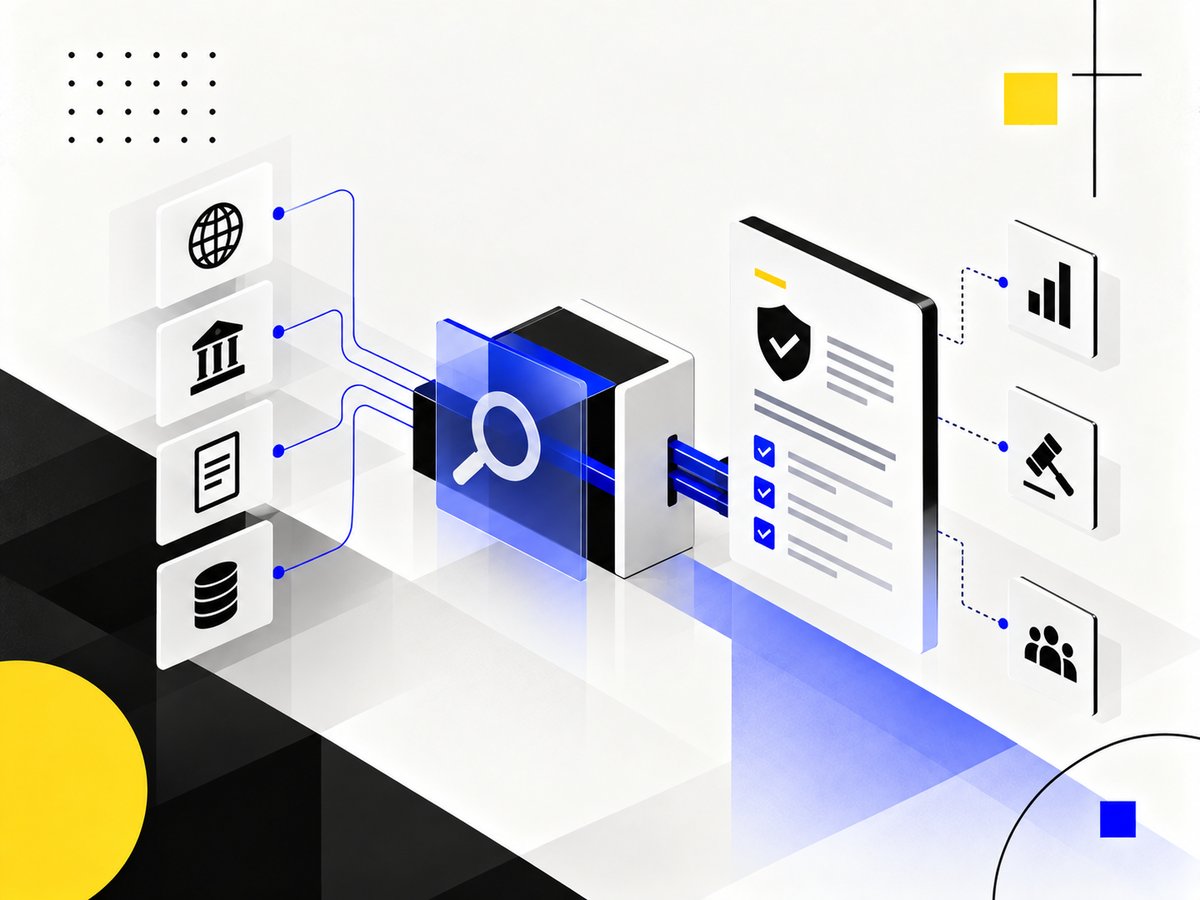
Compliance infrastructure often fails at the handoff between a completed task and the next material change. Teams may collect evidence, complete onboarding, and prepare for an audit, yet still lack a reliable way to revisit a counterparty when its leadership, website, risk signals, or regulatory environment changes. That gap becomes more visible as teams evaluate compliance software for more demanding operations. This matches what compliance teams report industry-wide: a regulatory monitoring survey found professionals rank tracking regulatory updates as the hardest part of change management, largely because manual methods cannot filter relevant changes or link them to obligations.[1]
What ComplyJet Users Should Test Before Switching
Compliance platforms can reduce manual uploads and spreadsheet tracking, but a serious evaluation should test whether the platform supports the full chain of investigation, decision, escalation, and later review across the firm's most consequential cases.
Evidence lineage: Trace each conclusion back to its source material.
Monitoring scope: Test material change detection after initial onboarding.
Reviewer control: Confirm analysts can inspect and challenge agent output.
Case context: Preserve rationale, approvals, and follow-up actions together.
Migration safety: Keep active reviews operational during cutover.
Auditability Is More Than an Audit Workspace
An audit workspace organizes artifacts, but auditability requires a reviewer to reconstruct how a conclusion was formed and what sources supported it. Audit logging and traceability help reviewers reconstruct the basis for a conclusion. For AML programs, FFIEC BSA/AML examination guidance addresses independent testing and recordkeeping, which makes a defensible decision trail operationally important rather than optional.[2]
Continuous Compliance Monitoring Versus One-Time Automation
The key distinction is not whether a platform automates work. It is whether it can keep a decision current after the original file closes. One-time automation reduces administrative effort; continuous compliance monitoring extends oversight into the period when customer, counterparty, and regulatory risk actually changes.
How Grep Changes the Operating Model
Grep is an AI deep-research and custom-agents platform for mission-critical work such as due diligence, institutional onboarding, and compliance oversight. Its Agent product produces traceable, citation-backed reports, slide decks, and spreadsheets, while Loops and Monitors run scheduled or event-triggered workflows and maintain an always-on screening surface for changes in companies, leadership, job postings, websites, and regulations.
This is a different operating model from a compliance program workspace. Rather than asking an analyst to restart a review when a signal appears, teams can define the event, create a research standard, and have Loops and Monitors continue the work.
The comparison below separates the disclosed capabilities that matter in a ComplyJet replacement decision. It does not treat a policy-and-evidence platform and a custom research-agent platform as identical products.
Decision area | ComplyJet | Grep |
|---|---|---|
Program evidence | ComplyJet states that it provides end-to-end compliance and automated monitoring | Traceable, citation-backed research deliverables |
Ongoing work | ComplyJet states that it provides automated monitoring | Loops and Monitors for scheduled, event-triggered, and always-on screening |
Audit support | Audit workspace and Trust Center | Exportable decision trails for audit |
Custom investigation | Policy templates are listed | Custom AI agents for due diligence and compliance reviews |
The deciding question is whether the team needs a fixed compliance framework, a deeper research layer, or both. For investigations where a regulator or board may ask why a conclusion was reached, source-backed analysis and preserved decision trails deserve the heaviest weighting.
Scale the Review, Not the Headcount
Financial institutions have already moved beyond experimentation: more than 60% have deployed AI in at least one AML or KYC function, up from 28% in 2021. AI KYC AML research also cites a blended range of roughly 50% to 80% false-positive alert reductions across the several studies it compiles, which can reduce manual review volume when controls, escalation paths, and evidence standards are designed into the process.[3]
Scaling compliance operations without headcount does not mean removing human judgment from high-risk decisions. It means directing analysts toward exceptions, source conflicts, and decisions that require accountable review, while agents handle repeatable research and monitoring work. Grep's strongest traction today is among large enterprises, particularly organizations with roughly 5,000 to 10,000+ employees, where distributed research standards and ongoing oversight become difficult to manage manually. This pressure is structural rather than seasonal: a global compliance concerns report names regulatory change outpacing manual processes as a top 2026 risk and calls for scalable, automated tracking in its place.[4]

How to Run an Enterprise Compliance Platform Comparison
A platform decision should be based on representative compliance cases, not a polished demonstration. Select work that exposes the pressure points: a complex institutional onboarding file, a counterparty requiring ongoing monitoring, and a review that must be summarized for senior oversight. This is where evaluating KYC vendors becomes an operating exercise instead of a procurement exercise.
Use a Defensibility Scorecard
Score each alternative on output traceability, source coverage, monitoring triggers, analyst controls, integration needs, security posture, and migration requirements. Ask each provider to demonstrate the same workflow end to end: ingest the relevant context, research the issue, produce a conclusion, cite the evidence, route it for review, and show how the record changes when a material signal appears.
Grep provides configurable retention with delete-on-request, scoped least-privilege credentials, no model training on customer data, and deployment options including VPC environments. Those controls should be evaluated alongside the workflow itself, because a decision about AI compliance software is incomplete if it cannot fit the organization's access, retention, and review requirements.
Stage the Transition Around Live Risk
Do not attempt a broad replacement before proving output quality on a bounded workflow. Keep the existing system of record in place, use the alternative on a defined class of reviews, compare analyst findings and source trails, then expand only after reviewers can explain the new process confidently. The strongest migration plan sets a clear owner for exception handling and a documented point at which the legacy workflow can be retired.
Pricing should be tested for transparency as well as total ownership. The relevant point is not price alone, but whether the commercial model is clear before a team invests time in a detailed evaluation. Teams weighing a replacement can also review switch to compliance automation timing before committing resources.

Conclusion
ComplyJet states that its published framework includes automated evidence collection, continuous monitoring, policy templates, an audit workspace, and a Trust Center. Teams considering a switch should test whether a replacement can continuously investigate material change and preserve a traceable record that explains each result. For banks and fintechs running high-stakes reviews, evaluate custom, citation-backed research and ongoing monitoring against the team's documented requirements. Start with one live workflow, validate the decision trail with the people who defend it, and expand only when the result is operationally trusted.
Ready to pressure-test a compliance workflow? Explore Grep's pricing and start with your team's real review requirements.
Frequently Asked Questions (FAQs)
How can AI agents improve compliance due diligence?
AI agents can improve compliance due diligence by gathering and synthesizing relevant research into a consistent deliverable, while leaving analysts responsible for validating evidence, resolving conflicts, and approving conclusions in sensitive cases.
Can AI agents provide auditable reports for regulators?
AI agents can provide auditable reports for regulators when each finding retains clear citations, the underlying source material is reviewable, and the organization records the human approvals and exceptions that shaped the final decision.
How do you scale compliance operations in large enterprises?
You scale compliance operations in large enterprises by standardizing repeatable research, routing only meaningful exceptions to specialists, and maintaining shared review standards across business units without sacrificing accountable human sign-off.
What makes an AI agent suitable for financial services?
An AI agent is suitable for financial services when it supports traceable outputs, controlled data access, clear review workflows, and evidence retention that compliance leaders can explain to auditors, internal risk teams, and regulators.
Is AI research for compliance defensible during an audit?
AI research for compliance is defensible during an audit when the organization can show the sources used, the logic behind the conclusion, the reviewer's approval, and the controls governing access and record retention.
What is the difference between generic AI and high-stakes compliance agents?
The difference is that high-stakes compliance agents are designed around controlled research, persistent context, citations, reviewability, and operational accountability, while generic AI commonly produces useful drafts without a complete decision record.
Sources
- Why Regulatory Monitoring Is Breaking Compliance Teams - FinTech Global ↩
- FFIEC BSA/AML Examination Manual - FFIEC ↩
- AI KYC and AML Automation Statistics 2026: Adoption, Efficiency, and ROI Data - Stealth Agents ↩
- 10 Global Compliance Concerns for 2026 - Thomson Reuters Institute ↩
About the Author