Deep Research Benchmarks Compared: DRACO and DeepSearchQA (2026)
See how the DRACO benchmark and DeepSearchQA compare in 2026, and what these deep research scores mean for choosing auditable AI research tools.
Quick Answer
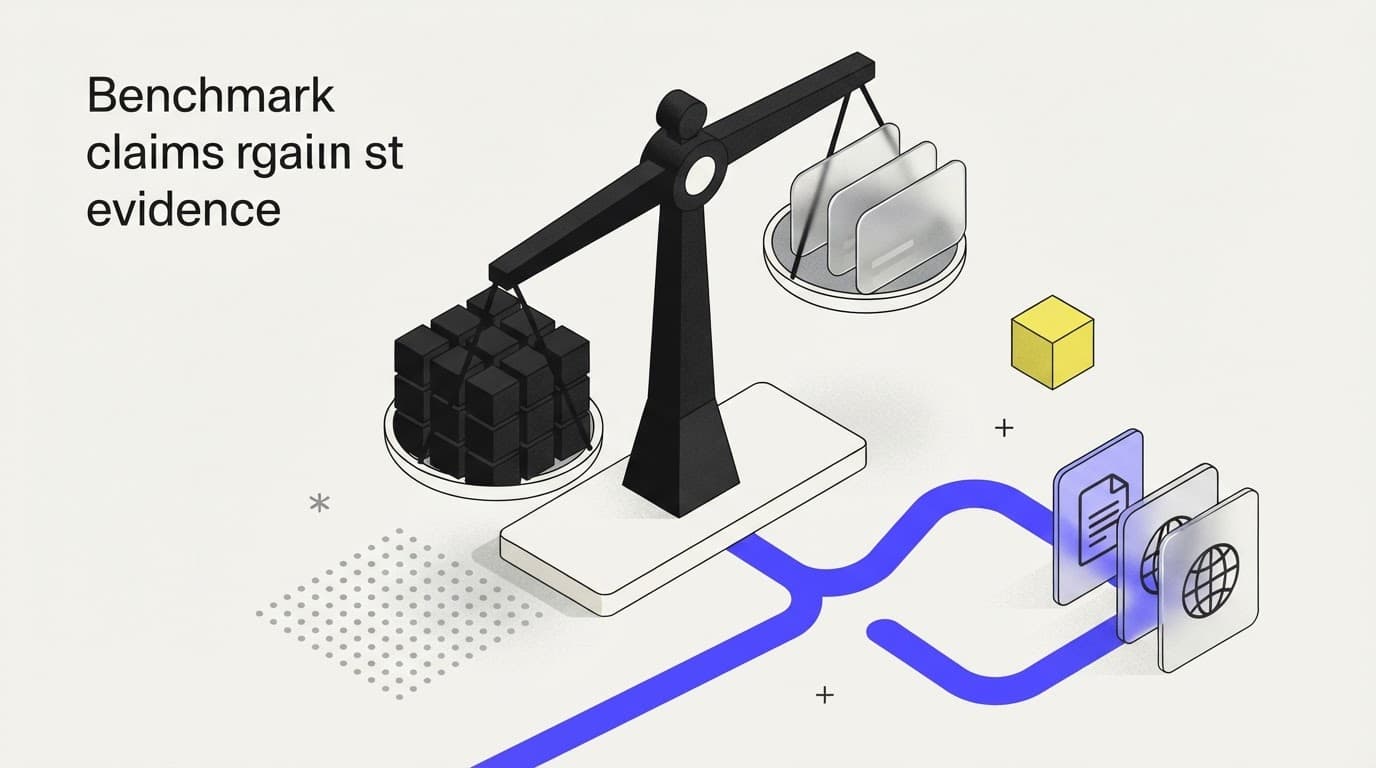
DRACO and DeepSearchQA measure different parts of deep research reliability: DRACO evaluates research quality across real-world domains, while DeepSearchQA tests whether an agent can execute complex search plans and produce exhaustive answer sets. For enterprise buyers, benchmark leadership is useful only when each result is paired with source-level evidence, reproducible scoring, and an audit trail that can withstand review.
Introduction
A result on the DRACO benchmark can help distinguish a research agent from a polished text generator, but it cannot prove that a due diligence report is defensible on its own. Compliance, KYC/AML, and investment teams need to know what a benchmark asked, what it scored, and whether the agent preserves the evidence behind every conclusion. As of April 2026, Grep published benchmark results across DRACO, DeepSearchQA, and DeepResearch Bench. That claim matters most when a buyer can inspect the research path rather than accept a leaderboard at face value.
Key Takeaways:
DRACO measures broad research performance across real-world domains.
DeepSearchQA tests exhaustive retrieval and complex search planning.
Auditable evidence matters more than a benchmark rank in regulated work.

How DRACO benchmark AI scoring tests research quality
DRACO is designed to assess deep research against realistic questions rather than simple fact lookup. Its coverage spans ten domains, including finance, law, medicine, technology, academic work, UX design, and shopping, and it is grounded in millions of real Deep Research queries on Perplexity’s platform. That breadth is useful for teams evaluating whether an agent can move between unfamiliar subjects without losing research discipline.
What DRACO reveals about an agent
The DRACO benchmark methodology is most useful when buyers treat it as a test of research execution, not as a certification of compliance readiness. Its rubrics were iteratively refined, with roughly 45% changed at least once, showing that evaluation quality depends heavily on how criteria are defined and maintained.
Domain breadth: Tests research across varied subject areas.
Rubric quality: Determines what counts as a passing answer.
Source coverage: Rewards research that addresses required evidence.
Claim support: Tests whether conclusions match cited material.
Why domain scores need context
Published DRACO results can show meaningful variation by domain. Those figures describe benchmark performance, not the completeness of a particular acquisition review, sanctions investigation, or board memo. Buyers should ask whether the vendor can expose the sources, exclusions, and reasoning that produced each final statement.
DeepSearchQA and DRACO measure different reliability risks
DeepSearchQA focuses on a narrower but operationally critical question: can an agent plan and execute a complex search process that finds a complete answer set? Its tasks are handcrafted to test difficult research plans and exhaustive lists, rather than single-answer retrieval or broad factuality. That makes it relevant to enterprise due diligence, where missing a material subsidiary, regulatory action, or executive role can change the decision.
Side-by-side benchmark interpretation
The following comparison shows why neither benchmark should be read as a universal quality score. Each captures a different failure mode that buyers should test against their own workflows.
Criterion | DRACO | DeepSearchQA | Enterprise implication |
|---|---|---|---|
Primary test | Research quality across domains | Complex search plans and exhaustive lists | Separates broad quality from completeness risk |
Task basis | Real Deep Research queries across ten domains | Handcrafted challenging research tasks | Check relevance to live internal cases |
Key output signal | Pass rates against evolving rubrics | Exact-set and correctness outcomes | Inspect underlying evidence and exclusions |
Known reported result | Perplexity DR: Law 89.4%; Academic 82.4% | Gemini Fully Correct: 66.09% | Scores require task-level interpretation |
DeepSearchQA’s reported results include a 66.09% Fully Correct rate for Gemini Deep Research Agent and 65.18% for GPT-5 Pro High Reasoning, with 95% confidence intervals reported alongside each result. A result like this is valuable because it quantifies exact-set success, but it also makes the remaining error rate visible, which matters when a missing item can alter risk judgment.
What benchmark leadership can and cannot prove
The DRACO benchmark paper, as published on arXiv, provides additional context for evaluating how the benchmark is framed.
Deep research benchmark results provide a useful external signal when methods, prompts, scoring criteria, and dates are available for scrutiny. Grep’s April 2026 claim across the three named benchmarks is therefore a starting point for evaluation, not a substitute for a controlled pilot using the buyer’s evidence standards. A benchmark does not establish whether reports include the decision trail a regulator, investment committee, or general counsel will request.
Turn benchmark scores into auditable research operations
For regulated financial services teams, traceable research means every conclusion should connect back to its source, scope, and decision context. A leaderboard can suggest that an agent researches well; it does not show whether an analyst can reconstruct why a report flagged a counterparty or omitted a claim. This is where research accuracy standards and performance benchmark data need to be translated into operating controls.
Ask vendors for an evidence-level demonstration
Request a live evaluation using a completed diligence case with known answers, then ask reviewers to test citations, missing-source handling, and materiality judgments. Compare the results with AI benchmark comparisons to keep the vendor review grounded in relevant evaluation criteria. The most important output is not a polished summary but a defensible report for board review that exposes claims, supporting records, and unresolved uncertainty. Benchmark methodology should inform those questions, but an enterprise pilot must test the actual data, policies, and approval workflow that govern production decisions.
Use monitoring to keep research current
One-time diligence becomes stale when corporate ownership, leadership, websites, job postings, or regulatory conditions change. Grep’s Agent can produce traceable, citation-backed reports and deliverables for high-stakes work, while its Loops and Monitors run scheduled or event-triggered workflows and continuous screening. For an acquisition target or institutional counterparty, that creates a practical path from initial review to ongoing oversight without treating the original report as permanent truth.
Conclusion
DRACO and DeepSearchQA are useful because they make different research failures measurable: weak multi-domain research and incomplete complex search. Enterprise teams should use scores to narrow a vendor shortlist, then require task-level evidence, clear scoring provenance, and an audit-ready decision trail. For compliance and diligence teams that need custom AI agents for high-stakes work, Grep is suited to requirements for traceable reports and continuous Loops and Monitors, not a benchmark score alone. Benchmark claims should always be dated, independently reviewed, and tested against the work that creates institutional risk.
Evaluate research outputs against your own control standards with Grep's research platform.
Frequently Asked Questions (FAQs)
What is the DRACO benchmark for AI research agents?
The DRACO benchmark for AI research agents evaluates deep research performance across ten real-world domains, using rubrics shaped by large volumes of platform queries and thereby testing more than isolated fact retrieval.
How does DeepSearchQA measure deep research accuracy?
DeepSearchQA measures deep research accuracy by using challenging handcrafted tasks that require agents to execute complex search plans and generate exhaustive answer lists, including exact-set and correctness-oriented outcomes.
Why is traceable AI research required for regulators?
Traceable AI research is required for regulators because regulated decisions must be reviewable through supporting sources, documented reasoning, scope boundaries, and a clear record of how a conclusion was reached.
What makes AI research defensible for a board of directors?
AI research becomes defensible for a board of directors when each material statement has accessible citations, unresolved issues are clearly identified, and reviewers can reconstruct the evidence behind the recommendation.
How to automate high-stakes due diligence with AI?
Automating high-stakes due diligence with AI requires a controlled workflow that defines required sources, routes exceptions to human reviewers, preserves citations, and continues monitoring material changes after the initial decision.
About the Author
Miguel Rios-Berrios is Founder and CTO of GREP.ai, with experience leading engineering and data science teams across fintech and distributed systems. His work focuses on AI agents for compliance, research reliability, and enterprise operations where outputs must remain auditable and defensible.