What Is AI Automation? A 2026 Guide for Compliance Teams
Explore what AI automation means for compliance in 2026 - from defensible due diligence to continuous monitoring with traceable, auditable AI agents.

Quick Answer
AI automation for financial services is the use of AI agents to carry out defined compliance work, retain the evidence behind each conclusion, and continue monitoring after the original review is complete. For regulated teams, the distinction is not whether an AI system can generate text, but whether its work is traceable, auditable, and defensible to a board or regulator.
Introduction
Compliance teams need AI automation that can support real decisions, not just accelerate a first draft. A generic assistant can summarize a policy or prepare an email, while an AI agent can investigate a counterparty, document its sources, apply a defined review process, and surface changes that require attention. Shopmonkey closed 64 research jobs in its first 30 days on Grep and cut underwriting research time from hours to minutes per account, beating Gemini head to head, a concrete example of what defensible automation looks like once it moves beyond drafting assistance. This matters because compliance teams still need to manage document-heavy, time-sensitive reviews while preserving a defensible record of how decisions were supported. The operational problem is not merely volume: it is proving why a decision was made after the fact.
Key Takeaways:
Compliance AI must preserve evidence and decision context.
Custom agents support repeatable high-stakes research workflows.
Continuous monitoring turns one-time reviews into ongoing oversight.
What AI Automation Means for Financial Services Compliance
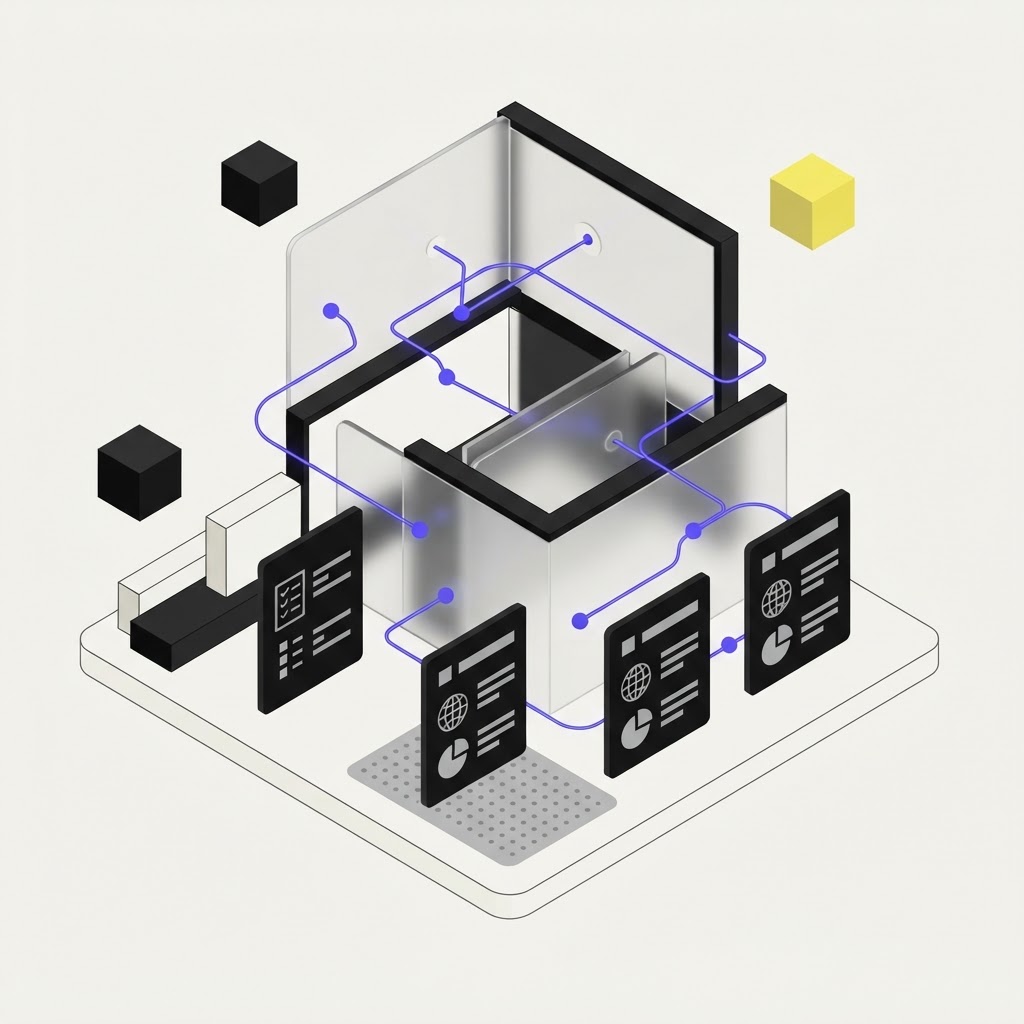
AI automation in a regulated setting combines task execution, evidence gathering, decision documentation, and human review. AI agents are software systems designed to perform specific tasks independently while working with business applications and data sources, but compliance use demands a narrower operating scope and a record of every consequential step. That is why the distinction between compliance agents and automation is meaningful: a workflow moves predefined data between systems, while an agent investigates, synthesizes, and flags judgment calls within defined controls.
From Static Workflows to Evidence-Bearing Agents
Basic automation follows a fixed route: collect a form, route it to an analyst, and record completion. An agent-based process can examine documents, research entities, reconcile conflicting information, and create a citation-backed output for review. In financial services, AI agents can support loan processing, fraud detection, customer queries, and regulatory compliance, but precision remains essential because the work touches customer records and risk decisions.
Defined scope: Agents operate within approved tasks and data access.
Evidence trail: Findings retain sources, reasoning, and review context.
Human escalation: Complex legal and risk judgments remain with people.
Persistent context: Prior research informs future reviews without replacing validation.
Why Traceability Is the Minimum Trust Bar
Speed is useful only when an analyst can inspect the inputs, source material, and output path behind a recommendation. An audit-ready KYC automation program should preserve exportable decision trails, identify the materials reviewed, and show where human approval changed the outcome. This is the core of auditable AI for regulatory oversight: the system must make review possible rather than asking teams to trust an opaque result.

Where AI Agents for Enterprise Compliance Apply
AI agents for enterprise compliance apply where teams repeatedly gather dispersed evidence, compare it against policy, and need a reliable record of the result. The most useful applications begin with a bounded, high-stakes use case, then expand only after the organization has established ownership, review rules, access controls, and escalation paths. According to Pitech Solutions, financial institutions using AI-driven compliance automation report reductions in document-processing time of 40% to 60% and improvements in compliance-inquiry response times of 30% to 50%, although these outcomes depend on mature governance and controlled deployment.
Onboarding, KYC, and Due Diligence
Institutional onboarding AI can assemble information from approved sources, identify missing documentation, and prepare an analyst-ready review package. It should not make a final risk determination without accountable human oversight, particularly where the work requires complex legal interpretation or decisions about institutional risk appetite.
For an acquisition, vendor, or counterparty review, the useful unit of work is a defensible dossier rather than a conversational answer. Custom AI agents can be configured around a firm's own policy logic, approved source set, deliverable format, and escalation standards, which is materially different from asking a general-purpose assistant to research a topic.
Grep is built for this category of work: its agents produce traceable, citation-backed reports, slide decks, and spreadsheets for due diligence, institutional onboarding, and compliance reviews. Its security posture includes SOC 2 and GDPR commitments, scoped least-privilege credentials, configurable retention, delete-on-request controls, and VPC deployment options, while customer data is not used for model training.
Continuous KYC and AML Automation
Continuous KYC and AML automation replaces the assumption that a completed review remains current. Loops and Monitors run scheduled or event-triggered work and watch for company website changes, leadership changes, job postings, and regulatory or compliance changes across regions. That model supports continuous AI monitors that direct analyst attention toward meaningful changes instead of repeated full-file reviews.
Alert triage is another practical use case because teams need a consistent way to prioritize review work and document escalation decisions. Any triage implementation still needs documented thresholds, sampled quality review, and clear accountability for escalation decisions.
Custom Agents Versus Generic AI Assistants
The practical question is not whether a team already has Microsoft Copilot, but whether it can produce a reviewable record for high-stakes work. Generic assistants are useful for drafting, summarization, and everyday knowledge work. Compliance agents need a defined operating scope, connections to approved data, repeatable research steps, persistent memory where appropriate, and an auditable record of findings and approvals.
Grep vs Microsoft Copilot for Compliance Work
The comparison between Grep and general-purpose productivity tools for compliance concerns operating models, not simply interface features. General-purpose assistants are commonly used for drafting and summarization, while Grep's custom-agent platform is designed around due diligence, institutional onboarding, compliance oversight, and continuous monitoring where outputs must be defensible.
Evaluation criterion | Generic productivity assistant | Custom compliance agent |
|---|---|---|
Primary task | Drafting and summarization | Defined high-stakes research workflows |
Evidence handling | Varies by task and configuration | Traceable, citation-backed deliverables |
Decision record | Documentation approach varies by implementation | Exportable audit trail supports review |
Monitoring model | Ad hoc, user-directed tasks | Scheduled and event-triggered Loops and Monitors |
Data governance | Depends on enterprise configuration | Scoped credentials, retention controls, VPC options |
The important tradeoff is governance effort. Industry reporting on AI implementation timelines commonly describes a proof of concept taking several weeks, while reaching production can take months once model-risk validation, legal review, data-residency remediation, and governance alignment are added. That gap is why buyers should evaluate operational controls before celebrating a polished demonstration.
What 2026 Buyers Should Evaluate Before Deployment
Start with the decision a regulator, auditor, or board member could challenge, then test whether the proposed system can reconstruct its work. Process maturity matters before technology selection because governance failures are usually process failures expressed through software. Teams should ask who owns policy changes, who approves exceptions, how sources are validated, how data access is limited, and how the system behaves when evidence conflicts.
Buyer reviews should also distinguish a research assistant from always-on enterprise research automation. Grep's Brain provides persistent memory and domain context behind every agent, while its Loops and Monitors maintain ongoing screening rather than treating every review as a blank-slate task. That is relevant for large enterprises pursuing AI transformation across departments, especially when one validated compliance use case can become a governed operating pattern.

Conclusion
AI automation for compliance is credible when it creates a reviewable chain from source material to decision support, not when it merely produces fluent text. Prioritize defined scope, human escalation, data controls, exportable decision trails, and ongoing monitoring before expanding deployment. For enterprises that need custom agents to run defensible due diligence and continuous compliance work, Grep is built to meet that trust bar. The goal is not to remove judgment from compliance, but to give judgment better evidence and a durable record.
Ready to assess your high-stakes workflow? Explore Grep for custom compliance agents and continuous monitoring.
Frequently Asked Questions (FAQs)
How to automate high-stakes compliance work?
High-stakes compliance work should be automated by defining a narrow task, limiting approved data access, requiring human escalation for material judgment, and preserving an exportable record of sources, findings, and approvals so each outcome can be reviewed later.
What makes AI research defensible for regulators?
AI research is defensible for regulators when the organization can show what information the agent accessed, how it reached each finding, which policy or review standard applied, and where accountable people validated or overrode the resulting recommendation.
Can AI agents conduct institutional onboarding?
AI agents can conduct institutional onboarding research by assembling customer information, identifying missing documentation, and preparing review materials, while final decisions involving risk appetite, complex legal interpretation, or exceptions should remain under accountable human control.
How does Grep differ from Microsoft Copilot for enterprise work?
Grep differs from Microsoft Copilot for enterprise work because it builds custom agents for due diligence, compliance oversight, institutional onboarding, and continuous monitoring with citation-backed outputs and exportable decision trails rather than relying on a general-purpose assistance model.
Why do enterprises choose custom AI agents over generic models?
Enterprises choose custom AI agents over generic models when they need a system tailored to approved data sources, internal policy logic, fixed deliverable formats, access restrictions, escalation rules, and ongoing review obligations that generic prompting does not consistently enforce.
How to maintain audit trails with AI automation?
Audit trails are maintained with AI automation by recording source inputs, agent actions, generated findings, analyst edits, approval events, access permissions, and retention decisions in a format that compliance, audit, and risk teams can export and inspect.
Can AI agents handle continuous KYC and monitoring?
AI agents can handle continuous KYC and monitoring by running scheduled or event-triggered checks for changes in customer, company, leadership, website, employment, regulatory, and compliance signals, then routing material changes to the responsible reviewer.
About the Author
Miguel Rios-Berrios is Founder and CTO of GREP.ai, with expertise in AI agents, distributed systems, engineering leadership, and fintech compliance. He has spent a decade building distributed teams and focuses on deploying enterprise AI for work that requires evidence, operational controls, and accountable review. Connect on LinkedIn.