Get started
Sources and citations
Where an answer's evidence lives, and what carries none at all.
Step 1
Sources depend on what you asked for
The first thing to check is whether it ran as research.
Whether an answer carries sources is decided by what Grep takes the request to be, not by the effort dial. A question it reads as a quick factual one is answered in the chat thread and stops there — no report, no sources count, no citations, no links out, just prose. That is working as intended, and no amount of reading the answer will show you where it came from.
A request Grep treats as research produces a report, and it can do that at any effort level. The chat gives a short summary and a report card with OPEN; the report opens beside the thread. Its header carries icons for Build, Track and Export and a time-saved counter, then the REPORT and FILES tabs, a SOURCES tab with the count, and EDIT beside the title.
What the three levels changeChecked against the product on October 15, 2026
Step 2
What sources are
The material Grep actually read, counted in the report header.
Sources are the pages, documents and references Grep used while working — company websites, public filings, articles, reports, documentation. The report header counts them, for example "SOURCES · 18", and the count is a tab: it opens the list, each source with its site and what it was used for.
- Which material Grep reviewed.
- Which of it supports the final answer.
- Whether a claim needs checking by hand.
- Where to read the original.
Checked against the product on October 15, 2026
Step 3
What citations are
The claim itself is the link.
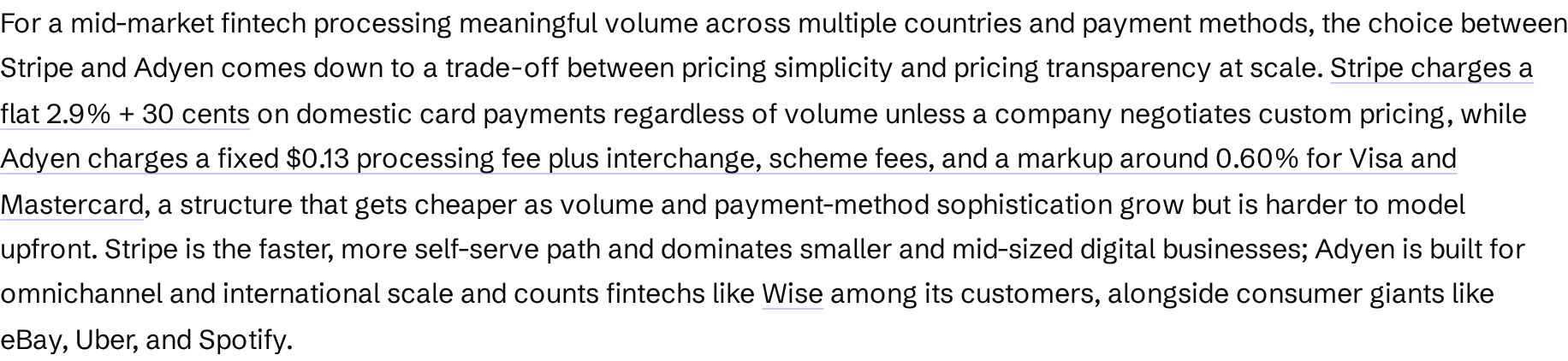
Grep does not use numbered footnotes. The claim is the link: the words carrying the fact — a price, a percentage, a named customer — are themselves a link to the page that says so. Hovering shows the destination, and clicking opens the source.
So a well-cited report reads as ordinary prose with the load-bearing phrases underlined, and a paragraph with no links in it is telling you something: that part is synthesis, not a sourced fact.
Checked against the product on October 15, 2026
Step 4
Review in three passes
Summary, then sources, then the claims that matter.
- Read the summary and confirm it answers what you asked.
- Open the sources and judge whether the material is good enough.
- Check the citations behind the claims your decision depends on.
Checked against the product on October 15, 2026
Step 5
When a source looks weak
Steer it with a follow-up.
If the material looks outdated, irrelevant or thin, do not start over. Ask a follow-up that says what you want leaned on. This usually helps, but treat it as steering rather than a filter: nothing here guarantees a source is excluded, so check the sources panel on the answer you get back.
- Use only sources from the last 12 months.
- Prioritise company websites, SEC filings and official announcements.
- Exclude blog posts and forum discussions.
- Find stronger evidence for the market size estimate.
Checked against the product on October 15, 2026